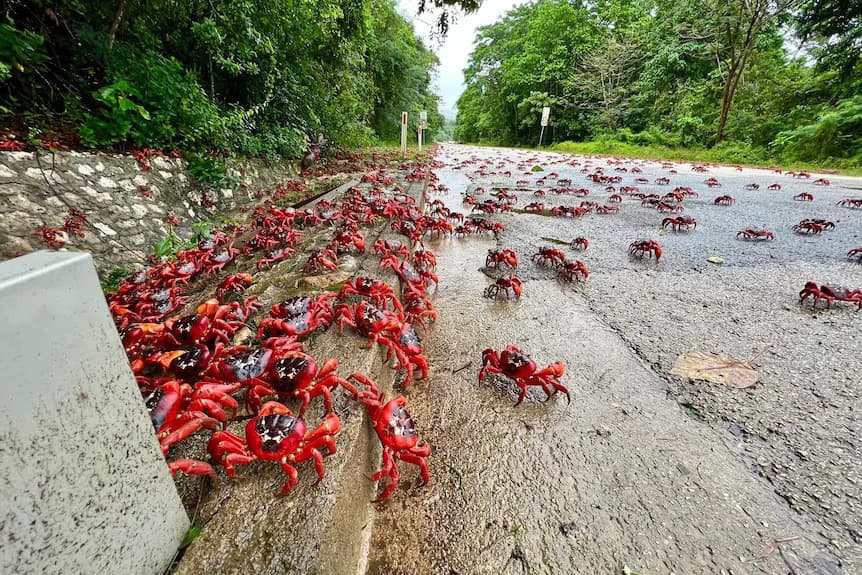
When tens of millions of red crabs begin their annual march to the sea, even the world's most ambitious internet infrastructure has to step aside.
There is something quietly wonderful about the fact that one of the most strategically important subsea cable projects in the Indo-Pacific right now is running on a schedule set not by engineers, not by regulators, but by crabs.
Google's Bosun cable is designed to connect Darwin in Australia's Northern Territory to Christmas Island, and from there onward to Singapore — a new digital corridor through the Indian Ocean that will meaningfully reduce latency and add resilience to data flows across the region. It's part of what Google is calling its Australia Connect initiative, and it matters a great deal for how the internet is plumbed across this part of the world. Christmas Island sits 1,500 kilometres southwest of the Australian mainland and just 350 kilometres south of Jakarta — a geographic sweet spot that shortens the cable arc between Australia and Southeast Asia, trimming the number of signal repeaters needed and cutting down on the small delays that quietly add up.
But once a year, Christmas Island belongs entirely to the crabs.
The Christmas Island red crab — Gecarcoidea natalis — is one of the great spectacles of the natural world. Tens of millions of them call the island home, and when the first rains of the wet season arrive, usually in October or November, they do something remarkable: every single adult begins walking toward the sea. Roads close. Heavy equipment stops. The forest empties out as a slow crimson tide flows downhill to the coast, where the crabs spawn at the shoreline — always at dawn, always on a receding high tide, always in the last quarter of the moon. They know. They have always known. It is one of those natural clocks that runs with a precision no algorithm has managed to replicate.
I find myself thinking about this whenever someone asks me what the internet actually is. We tend to imagine it as something abstract — data floating in clouds, signals bouncing through nothing in particular. But so much of it runs through physical cable, buried under ocean floors, landing on real shores, threading through real ecosystems. Christmas Island makes that unusually vivid. You cannot run a fibre-optic cable through the world's most biodiverse tropical island without the island having a say in the matter.
The name Bosun, as it turns out, is a small piece of poetry. It refers to the White-tailed Tropicbird — known locally as the Bosun bird for the long white tail feather that resembles a boatswain's spike — one of the most distinctive birds on the island. It also means the senior deckhand on a vessel: the person responsible for the physical fabric of the ship. It's a name that manages to carry both the place and the sea at once. Someone at Google was paying attention.
There is a broader point here that is easy to overlook. The crabs are not a problem to be solved. According to Parks Australia, they are an ecological keystone — as they migrate, they aerate the soil, disperse seeds, and clear the forest floor of leaf litter in ways the whole ecosystem depends on. Google isn't fighting them. By all accounts, the construction schedule is being coordinated with Australian authorities to work around the migration window entirely. The crabs don't know about the cable. They don't need to.
What I keep coming back to is the scale of the thing on both sides. Tens of millions of crabs, moving as one, following lunar tides and seasonal rhythms that predate the internet by a very long margin, have no interest in global connectivity. And for a few weeks a year, the global connectivity project has to get out of their way.
I think that's worth knowing. The internet doesn't just connect cities and continents — it threads through places like this. Places where the engineering brief occasionally includes a line that reads: wait for the crabs.
— Jeffrey